
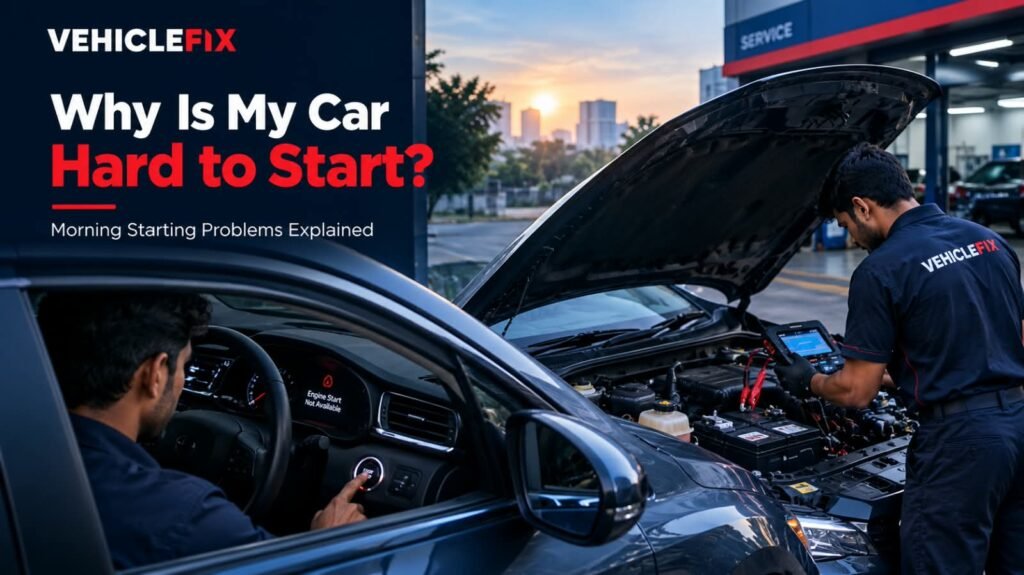

Have you ever turned the key or pressed the start button in the morning, only to find that your car takes several seconds to start—or refuses to start at all?
A car that has difficulty starting in the morning can be frustrating, especially when you are rushing to work or an important appointment. While occasional starting problems may not always indicate a major issue, repeated morning starting difficulties can be a sign that your car needs professional inspection.
Cold temperatures, a weak battery, fuel-system problems, worn spark plugs, electrical faults, and engine issues can all affect starting performance.
In this guide, we explain the common reasons why your car is hard to start in the morning, what symptoms to watch for, and when you should take your car to a professional car service center.
Common Reasons Why Your Car Is Difficult to Start in the Morning
1. Weak or Aging Battery
One of the most common causes of morning starting problems is a weak car battery.
When the engine is switched off overnight, the battery must provide enough power to operate the starter motor and ignition system when you start the car. If the battery is weak, the starter may turn slowly or you may hear a clicking sound.
Common signs of a weak battery include:
- Slow engine cranking
- Clicking sound when starting
- Dim headlights
- Electrical accessories working slowly
- Car starts after multiple attempts
- Battery warning light appearing on the dashboard
If your battery is several years old or repeatedly loses charge, it should be tested professionally.
2. Faulty or Worn Spark Plugs
Petrol engines depend on spark plugs to ignite the air-fuel mixture inside the cylinders. Over time, spark plugs can become worn, dirty, or covered with carbon deposits.
When spark plugs are not producing a strong spark, the engine may take longer to start.
You may also notice:
- Rough idling
- Engine misfires
- Reduced fuel efficiency
- Poor acceleration
- Engine vibration
- Check engine light
Replacing spark plugs at the recommended service interval can help maintain reliable engine starting and smooth performance.
3. Fuel System Problems
Your engine needs the correct amount of fuel at the correct pressure to start properly. Problems with the fuel pump, fuel injectors, fuel filter, or fuel-pressure system can make starting difficult.
A failing fuel pump may not build sufficient pressure after the car has been parked overnight. Dirty fuel injectors can also affect fuel delivery.
If your car cranks normally but takes several attempts to start, the fuel system should be checked.
4. Dirty or Faulty Air Filter
The engine requires both fuel and air for combustion. A severely dirty air filter can restrict airflow and affect engine performance.
Although an air filter alone is not always the reason for a hard-starting engine, it can contribute to poor combustion when it is heavily clogged.
Regular air-filter inspection is particularly important if you frequently drive in dusty or polluted environments.
5. Engine Oil That Is Old or Incorrect
Engine oil lubricates the internal components of your engine. If the oil is old, contaminated, too thick, or the wrong grade for your engine, it can increase resistance during starting.
This can be more noticeable after the car has been parked for many hours.
Using the manufacturer-recommended engine oil grade and changing the oil at the correct interval can help maintain smooth engine operation.
6. Alternator or Charging System Problems
Sometimes the battery is not the actual problem. A faulty alternator or charging system may fail to recharge the battery properly while you drive.
As a result, the car may start normally one day but struggle the next morning.
Signs of a charging-system problem can include:
- Battery repeatedly going flat
- Battery warning light
- Flickering lights
- Electrical problems
- Difficulty starting after overnight parking
A technician can test the battery, alternator output, and charging system to identify the actual cause.
7. Faulty Sensors
Modern cars use multiple sensors to control fuel injection, ignition timing, and engine operation.
A faulty engine coolant temperature sensor, crankshaft position sensor, camshaft position sensor, or mass airflow sensor can cause starting difficulties.
For example, if the engine-control system receives incorrect temperature information, it may not provide the appropriate fuel mixture during startup.
Diagnostic scanning can help identify sensor-related faults.
8. Starter Motor Problems
If you turn the key or press the start button and hear a clicking noise—or the engine cranks very slowly—the starter motor may need inspection.
A worn starter motor can develop problems with its internal components, electrical connections, or solenoid.
A professional technician can check whether the problem is coming from the battery, wiring, starter motor, or another electrical component.
Why Does My Car Start Normally Later in the Day?
If your car struggles to start in the morning but starts normally later, the issue may be related to:
- Battery condition
- Fuel pressure
- Engine temperature sensors
- Ignition components
- Electrical connections
- Fuel-system pressure retention
- Engine management sensors
The fact that the car starts later does not necessarily mean the problem has disappeared. Repeated symptoms should be diagnosed before the vehicle eventually fails to start completely.
What Should You Check If Your Car Is Hard to Start?
Before visiting a workshop, pay attention to what happens when you start the car.
If the engine cranks slowly:
The battery, battery terminals, starter motor, and charging system should be checked.
If the engine cranks normally but doesn’t start:
The fuel system, ignition system, sensors, and engine-control system may require inspection.
If the engine starts but runs roughly:
Technicians should check spark plugs, ignition coils, injectors, air intake, sensors, and possible engine-management faults.
If you hear clicking:
The battery, starter circuit, terminals, and starter motor should be inspected.
These symptoms can help technicians narrow down the cause more quickly.
Can Regular Car Service Prevent Starting Problems?
Regular maintenance can reduce the likelihood of unexpected starting problems.
During routine car service, technicians can inspect important components such as:
- Battery and charging system
- Spark plugs
- Engine oil
- Air filter
- Fuel system
- Starter motor
- Electrical connections
- Engine sensors
- Diagnostic fault codes
Preventive maintenance is generally easier and less disruptive than dealing with a vehicle that suddenly refuses to start.
When Should You Visit a Car Service Center?
You should have your vehicle inspected if:
- It takes multiple attempts to start every morning
- The engine cranks slowly
- The battery repeatedly becomes weak
- You hear unusual clicking or grinding noises
- The check engine light is on
- The car stalls after starting
- Fuel efficiency has suddenly decreased
- The engine runs roughly after starting
Ignoring repeated starting problems can sometimes lead to a complete breakdown.
Professional Car Service in Hyderabad
If your car has difficulty starting in the morning, the cause could be something as simple as a weak battery or spark plugs, or it could require a deeper inspection of the fuel, electrical, ignition, or engine-management systems.
At VehicleFix, trained technicians can inspect your car and use diagnostic equipment to help identify the underlying problem instead of simply replacing parts without proper testing.
Whether you need battery inspection, engine service, diagnostics, spark plug replacement, electrical repair, or general car maintenance, professional diagnosis can help get your vehicle back to reliable starting performance.
Frequently Asked Questions
Why is my car hard to start only in the morning?
A weak battery, fuel-pressure issue, worn spark plugs, faulty sensors, or electrical problem can cause difficulty starting after the car has been parked overnight.
Why does my car crank but not start?
If the engine cranks normally but does not start, the problem may involve fuel delivery, ignition, sensors, or the engine-management system. Professional diagnostics can help identify the cause.
Can a weak battery cause slow starting?
Yes. A weak battery may not provide enough power to turn the starter motor at the required speed, resulting in slow or difficult starting.
How often should I check my car battery?
Battery condition should be checked during routine servicing, particularly if the battery is aging or the vehicle is showing signs of slow cranking or electrical problems.
Is difficulty starting a serious car problem?
It can be a warning sign of an underlying battery, electrical, fuel, ignition, or engine issue. If the problem happens repeatedly, it is better to have the vehicle inspected before it develops into a no-start situation.
Final Thoughts
A car that struggles to start in the morning should not be ignored, especially when the problem happens repeatedly. The cause could range from a weak battery or worn spark plugs to fuel-system, starter, sensor, or electrical problems.
The best approach is to identify the actual cause through proper inspection and diagnostics rather than repeatedly attempting to start the vehicle.
If your car is taking longer than usual to start, get it checked early and avoid being stranded unexpectedly.
VehicleFix – Professional Car Service in Hyderabad
Book your car service today: +91 80192 24740
Website: vehiclefix.in