
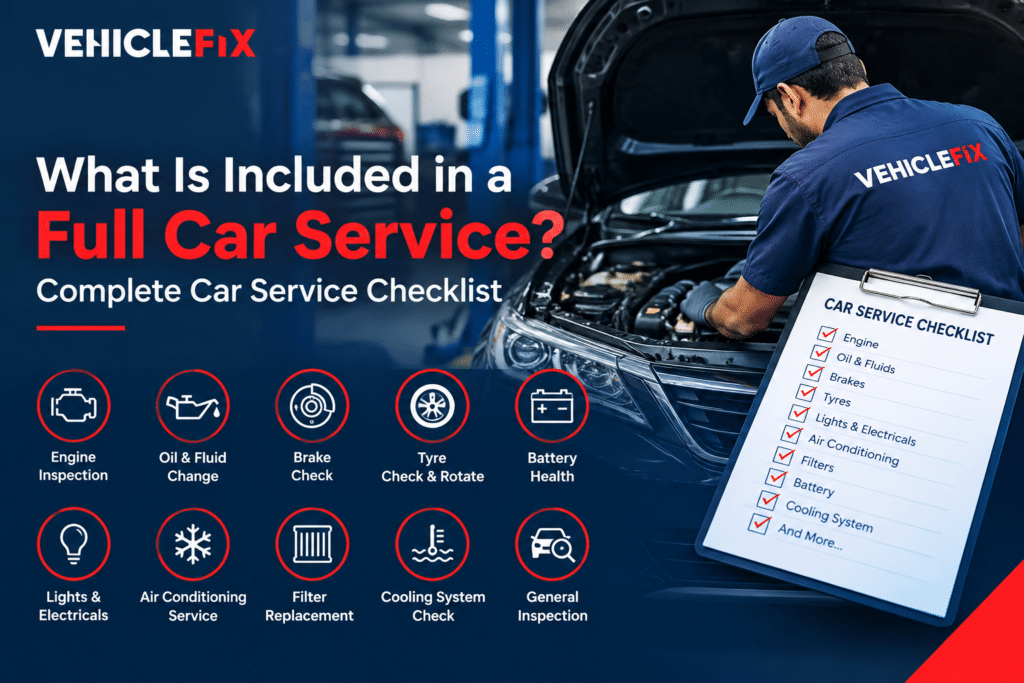
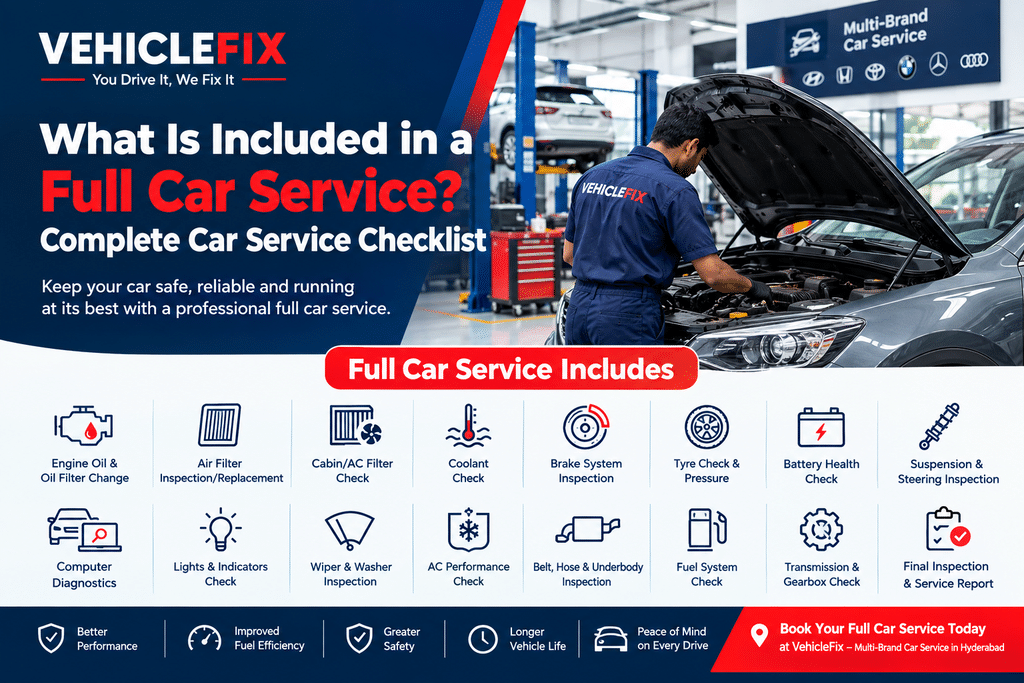
Quick Answer: A full car service typically includes engine oil and oil filter replacement, air filter inspection/replacement, fluid checks and top-ups, brake inspection, tire inspection, battery and electrical checks, steering and suspension inspection, AC checks, diagnostic scanning, lights and wipers inspection, and a final vehicle check. Additional repairs or replacements are generally recommended only when required.
A comprehensive inspection and maintenance procedure known as a “full car service” examines your vehicle’s engine, fluids, filters, brakes, tires, battery, suspension, steering, electrical systems, air conditioning, and other essential components.
A full car service, in contrast to a standard oil change, aims to catch potential issues early, maintain vehicle performance, increase reliability, and assist in avoiding unexpected breakdowns.
At VehicleFix, we offer expert multi-brand auto service in Hyderabad that is tailored to the make, model, age, mileage, and manufacturer-recommended service schedule of your vehicle.
What Is a Full Car Service?
A full car service is a detailed preventive maintenance service performed to check the overall condition of a vehicle. It is more complete than a typical oil change or vehicle service. Depending on the vehicle and manufacturer’s service plan, technicians may evaluate various systems and components.
A typical full car service can include:
- Engine oil change
- Oil filter replacement
- Air filter inspection or replacement
- Cabin/AC filter inspection
- Coolant inspection
- Brake fluid inspection
- Battery health check
- Brake system inspection
- Tyre inspection and pressure check
- Steering and suspension inspection
- Electrical system inspection
- AC performance check
- Diagnostic scanning
- Lights and indicators check
- Wiper and washer inspection
- Drive belt and hose inspection
- Underbody inspection
- Road test
- Service reminder reset
- Service report
The exact checklist can vary according to the car manufacturer, model, mileage, age and service interval.
Full Car Service Checklist
1. Engine Oil Change: (Full Car Service)
One of the most crucial aspects of routine vehicle maintenance is engine oil.
Typically, technicians performing a full car service:
- Check engine oil condition
- Drain old engine oil
- Refill the correct grade of engine oil
- Check the engine oil level
- Inspect for visible oil leaks
Using the oil specification recommended by the vehicle manufacturer is important because different engines require different oil grades and specifications.
2. Oil Filter Replacement: ( Full Car Service)
The engine oil is cleaned of contaminants by the oil filter. A clogged or old oil filter can reduce the effectiveness of lubrication. The oil filter is typically replaced during a full service in accordance with the manufacturer’s service schedule.
3. Air Filter Inspection and Replacement: (Full Car Service)
The engine needs clean air for efficient combustion. The technician examines the air filter in the car for:
- DustDirt
- Blockage
- Damage
- Excessive contamination
It is possible to replace the filter if it is dirty or due for replacement. A clean air filter can help maintain proper engine performance.
4. Cabin or AC Filter Check: (Full Car Service)
The cabin filter, also called the AC filter or pollen filter in some vehicles, helps filter dust and particles entering the passenger cabin.
A service inspection might look for:
- Filter condition
- Dust accumulation
- AirflowOdour
- AC performance
The frequency of replacement is determined by the schedule provided by the vehicle manufacturer and the condition of the filter.
5. Coolant Check: (Full Car Service)
Coolant for the engine aids in temperature control. During a full car service, technicians can check:
- Coolant level
- Coolant condition
- Visible leaks
- Radiator condition
- Coolant hoses
- Expansion tank
Instead of repeatedly topping off the coolant, it’s better to find out why the level is low.
6. Brake System Inspection: ( Full Car Service)
An essential component of a comprehensive auto service is a brake inspection. Technicians may inspect:
- Brake pads
- Brake discs
- Brake drums
- Brake shoes
- Brake fluid
- Brake hoses
- Brake calipers
- Handbrake/parking brake
- ABS warning indicators
Repair or replacement of a component in the brake system may be required if excessive wear is evident.
Important: Typically, replacing brake discs or pads is an additional repair rather than a standard part of every service package.
7. Brake Fluid Check:
The braking system is where hydraulic pressure is transferred by brake fluid. During maintenance, technicians can check the following:
- Brake fluid level
- Fluid condition
- Visible leaks
- Manufacturer-recommended replacement interval
The vehicle manufacturer’s recommendations and the fluid’s condition should be followed when replacing brake fluid.
8. Battery Health Check:
A professional battery service might include checking the following
- Battery voltage
- Battery condition
- Battery terminals
- Corrosion
- Charging system
- Battery health
Battery testing is especially useful for modern automobiles because numerous electrical systems rely on stable battery voltage.
9. Tyre Inspection:
For braking, handling, and road safety, tires are necessary. A thorough vehicle inspection might look for:
- Tyre pressure
- Tread condition
- Uneven tire wear
- Sidewall damage
- Cracks
- Punctures
- Tyre age
- Spare tire condition
Technicians may also recommend wheel alignment, wheel balancing or tire rotation if required
10. Wheel Alignment and Balancing:
Wheel alignment ensures that the wheels are suitably positioned according to vehicle specifications.
You may require an alignment check if you observe:
- Vehicle pulling to one side
- Uneven tire wear
- Steering wheel not centred
- Handling changes
Wheel balancing corrects uneven weight distribution in a wheel and tire combination. Imbalance symptoms can include steering-wheel or vehicle vibration, especially at high speeds.
11. Steering and Suspension Inspection:
A complete car service should include an inspection of critical steering and suspension components. Technicians can inspect:
- Shock absorbers
- Suspension bushes
- Ball joints
- Tie rods
- Steering components
- Stabilizer links
- Steering rack
- Suspension mounts
Worn suspension components can affect ride comfort, handling and tire wear.
12. Engine Belt and Hose Inspection:
Technicians can check visible belts and hoses for:
- Cracks
- Wear
- Looseness
- Damage
- Leaks
- Deterioration
The replacement interval for components such as timing belts varies by vehicle, so it should be checked against the manufacturer’s service schedule. A typical full service does not automatically include a timing belt replacement because it is typically a scheduled maintenance task.
13. Car AC Check:
A basic AC inspection may be included in a comprehensive car service. Technicians can look for:
- Cooling performance
- AC airflow
- Cabin filter
- Compressor operation
- Visible leaks
- AC-related components
If your car’s AC is not cooling properly, additional car AC service, AC gas charging, compressor repair or AC diagnostics may be required.
Electrical System Inspection:
There are several electronic systems in today’s autos. A service inspection may involve checking:
- Headlights
- Tail lights
- Brake lights
- Indicators
- Hazard lights
- Reverse lights
- Horn
- Power windows
- Central locking
- Dashboard warning lights
- Wipers and washers
Modern automobiles may also necessitate computerized diagnostics to locate stored trouble codes.
Computer Diagnostic Scan
Fuel Filter Check
Transmission and Gearbox Check
Wiper and Washer Check
Underbody Inspection
Road Test:
After servicing, a road test may be performed to assess:
- Engine performance
- Braking
- Steering
- Gear shifting
- Suspension behaviour
- Unusual noises
- Vehicle vibration
- Warning lights
Technicians can use a road test to see if the symptoms they reported have gone away and if there are any new problems.
Final Inspection and Service Report :
The following should be communicated in a professional workshop:
- Inspected
- Replaced
- Repaired
- Recommended
- Deferred for later
The owner of the vehicle receives a more precise record of the work done in a service report.
Benefits of Regular Full Car Servicing
Regular maintenance can help you:
- Maintain Engine Performance: Maintaining the engine’s oil and filters on a regular basis keeps it running smoothly.
- Identify Problems Early: Inspections can find worn or broken parts before they become more serious issues.
- Maintain Safety: Checks of the brakes, tires, suspension, steering, and electrical systems can assist find problems that compromise the safety of a car.
- Support Better Fuel Efficiency: Although fuel economy depends on a number of variables, such as driving conditions, tire pressure, vehicle condition, and driving style, a well-maintained car can run more efficiently.
- Reduce Unexpected Breakdowns: Preventive maintenance aids in addressing planned maintenance and emerging problems before they become unplanned malfunctions.
- Maintain Vehicle Value: It is possible to prove that the car has been properly maintained by keeping service records and adhering to the manufacturer’s maintenance plan.
Why Choose VehicleFix for Full Car Service in Hyderabad?
VehicleFix offers expert multi-brand auto repair for various makes and models in Hyderabad. Among the auto maintenance services we offer are:
- Periodic car service
- Full car service
- General car service
- Engine service
- Car diagnostics
- Brake service
- Battery service
- AC service
- Suspension service
- Steering service
- Wheel alignment
- Wheel balancing
- Car detailing
- Denting and painting
- Luxury car service
- EV maintenance
VehicleFix assists you in getting your automobile inspected and serviced in accordance with its condition and maintenance needs, whether you’re looking for car service near me, the best car service center in Hyderabad, car repair near me in Hyderabad, or a trustworthy multi-brand car service facility.
1. What is included in a full car service package?
A full car service package generally includes engine oil and oil filter replacement, fluid checks, air filter inspection, brake and tyre inspection, battery check, steering and suspension inspection, electrical checks, diagnostics, and a final vehicle inspection. In addition, some service centers may offer extra repairs or maintenance depending on your car’s condition.
2. How much does a full car service with engine oil change cost?
The full car service cost with an engine oil change depends on your car’s make, model, oil type, and service requirements. However, the final price may increase if additional repairs or replacement parts are needed. Therefore, it is better to check the service package and get a price estimate before booking.
3. Can I get brake pad replacement as part of a full car service?
Yes, you can get brake pad replacement during a full car service if the pads are worn or damaged. However, brake pads are usually inspected first and replaced only when necessary. In addition, the brake pad replacement cost depends on your car model and the type of parts required.